If you’ve been in networking long enough, you’ve had that moment: staring at a topology diagram at 2 AM, trying to figure out why half your routers are “Init,” one is “ExStart,” and another has gone completely “Full” with the wrong neighbor like it’s speed dating.
Welcome, my friend, to OSPF—the protocol that is equal parts brilliant, bureaucratic, and occasionally unhinged.
Over this series, we’re going to demystify OSPF—Open Shortest Path First, although I prefer Obviously Someone Prefers Frustration (only when its broken). By the end, you’ll not only understand how it works but actually appreciate the elegance hidden under all those LSAs, areas, and adjacency states.
Let’s kick things off by getting acquainted with the star of our show!
What Exactly Is OSPF?
OSPF is a link-state routing protocol, which means it doesn’t just swap gossip with the neighbors—it builds a full map of the network. Think of it as the protocol equivalent of that coworker who keeps a whiteboard diagram updated to the minute and insists on telling you every tiny detail.
Every router:
- Learns the topology
- Builds a local map
- Calculates shortest paths
- Recomputes when the network changes
That last part is where the magic — and the pain — lives.
OSPF doesn’t guess. It calculates. And those calculations reflect the design choices you make.
Why Network Architects Still Choose OSPF
OSPF has been around for decades, yet it remains a staple in enterprise and large-scale environments. That longevity isn’t accidental.
Architects value OSPF for a few key reasons:
- Deterministic behavior — Given the same inputs, OSPF produces predictable outcomes.
- Fast convergence — Topology changes are propagated quickly and recomputed efficiently.
- Hierarchical scalability — Areas allow you to bound failure domains and control complexity.
- Loop-free by design — The link-state model prevents many classic routing pathologies.
- Vendor neutrality — OSPF remains one of the most universally supported IGPs.
This image shows how having a hierarchy unlocks that OSPF cheat code
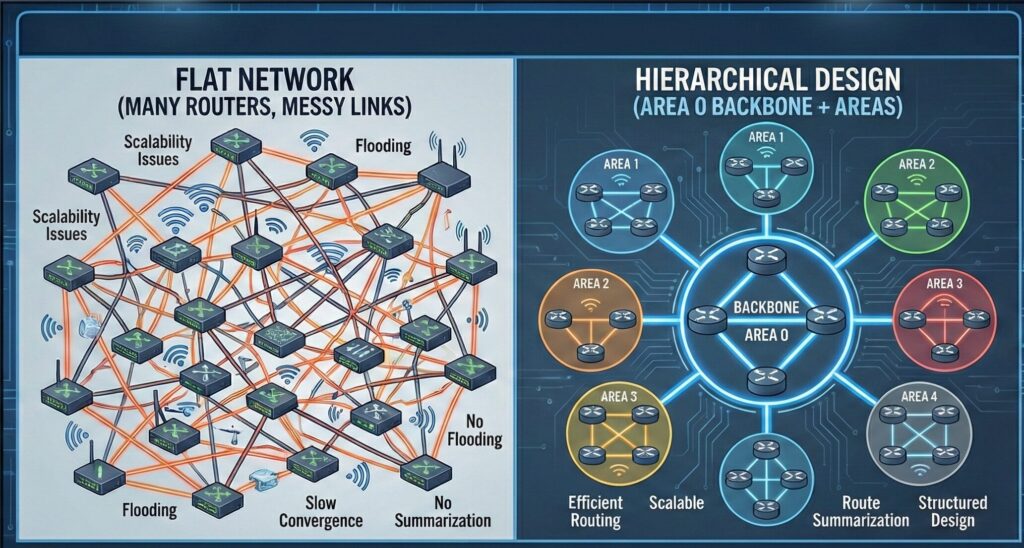
Architects don’t love OSPF because it’s simple. We love it because it’s predictable.
The Link-State Mindset
Before OSPF installs a single route, it builds a model of the network.
1. Discover neighbors
2. Form adjacencies
3. Exchange LSDBs (Link-State Databases)
4. Run SPF (Dijkstra’s algorithm)
5. Install best paths
If distance-vector protocols are like “I heard from someone who heard from someone else…,” then OSPF is:
“Here are the blueprints, timestamps, and notarized schematics for every link. Please initial each page.”
That independence is powerful — and unforgiving. If the topology database is wrong, every router will confidently make the wrong decision.
Adjacencies: Where Most Problems Begin
OSPF neighbors don’t instantly trust each other. They progress through a series of states as they synchronize their view of the network:
• Down — “I don’t know you.”
• Init — “I saw your Hello.”
• 2-Way — “We’re cool.”
• ExStart — “Let’s fight about who’s in charge.”
• Exchange — “Here’s all my LSAs, judge as you will.”
• Loading — “I’ll take those LSAs, thanks.”
• Full — “We’re soulmates now.”
Each transition represents increasing trust and synchronization.
And each state is a potential troubleshooting clue when things go wrong.
In practice, many OSPF issues trace back to failures in this lifecycle — mismatched timers, MTU inconsistencies, authentication drift, or design mistakes that surface during adjacency formation.
We’ll deep-dive each of these in a later post—trust me, it’s going to be fun. As you can tell my idea of fun, might not what you think fun is, but as my son would say “Trust…”
What’s Coming in the Series
What am I going to cover in this series? I am glad you asked. I am going to focus on the basics and in some of the posts throw in some videos where we will see OSPF in action.
OSPF Neighboring: Making (and Breaking) Friendships
Adjacency states, DR/BDR elections, Hello packets, and why one misconfigured timer can ruin your day.
Areas: OSPF’s Attempt at Keeping Chaos Contained
Backbone area, stub areas, NSSAs, virtual links, and why “just make everything Area 0” is the cry of a network engineer who has given up.
LSAs Explained: The OSPF Postal Service
Type 1 through Type 7, what they mean, who generates them, and why some are more troublesome than others.
SPF Algorithm: Dijkstra and the Math That Saves Your Network
Not scary, I promise. We’ll break it down like a story problem you actually care about.
OSPF Design Tips from Someone Who’s Been Burned Before
Best practices, real-world architectures, multi-area designs, pitfalls, and war stories.
Troubleshooting OSPF Without Crying (Much)
Packet captures, debugging commands, and how to fix 90% of OSPF issues in 10% of the time.