Welcome back to our OSPF adventure—where packets are polite, adjacencies are dramatic, and routers have the emotional range of a Shakespeare character arc. Today we’re tackling OSPF neighbor states explained the way architects actually experience them—from the first Hello to full adjacency and everything that breaks along the way.
It has to talk to another router and try to be friendly
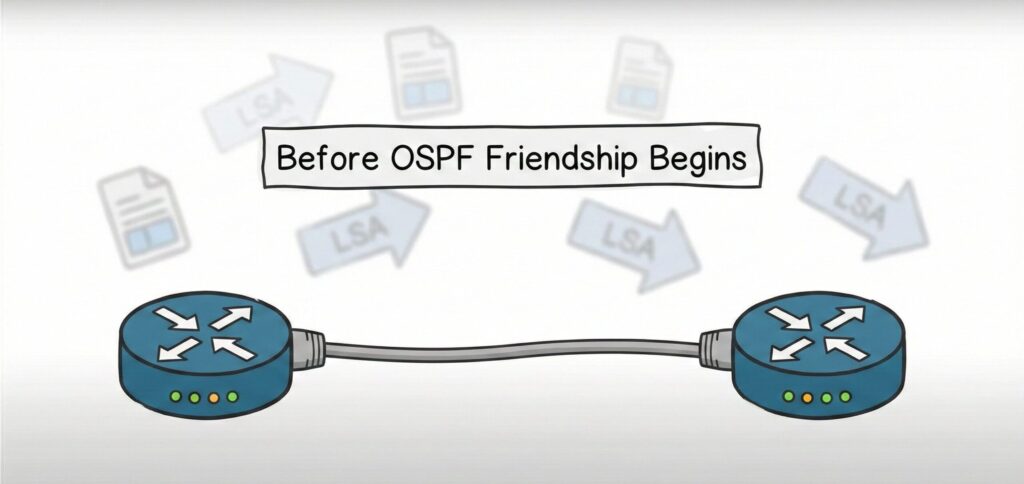
Hellooo? The OSPF Handshake
OSPF starts every relationship with a Hello packet, which is basically a router’s Tinder profile:
• Here’s who I am
• Here’s my Router ID
• Here’s our area
• Here are my timers
• Here’s our network mask
• Here’s the DR and BDR I think exist
• Here are the neighbors I already like
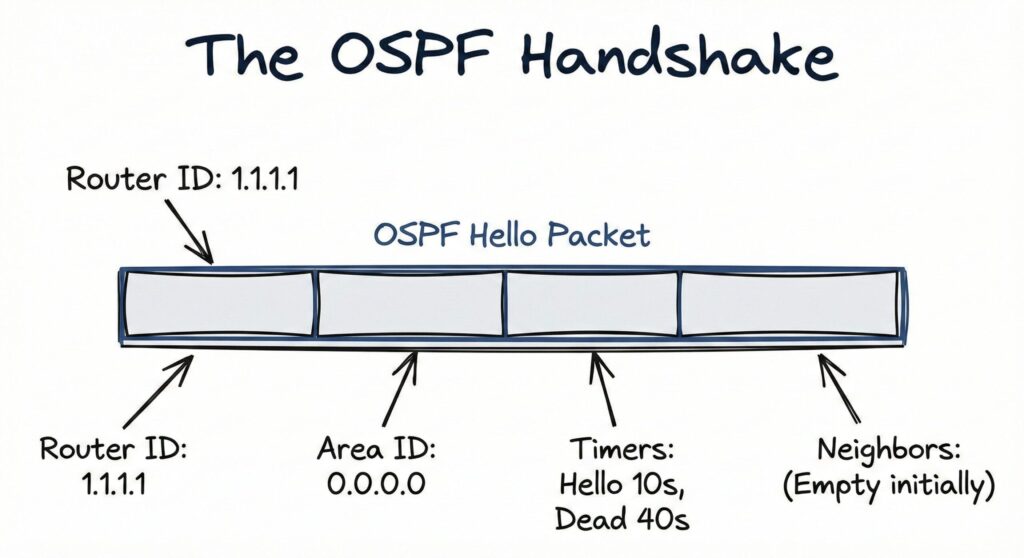
If two routers’ profiles match closely enough, OSPF says:
“Great—we can be friends.”
If they don’t match?
OSPF says:
“We are fundamentally incompatible; please never speak to me again.”
Yes, it’s that dramatic. It’s like that tinder date that went sideways.
⸻
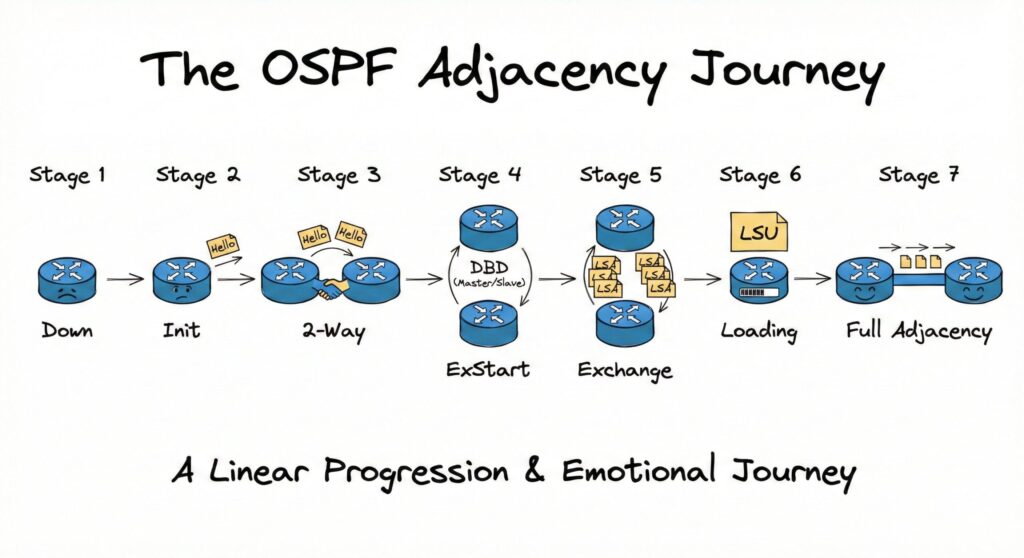
The 7 Stages of OSPF Friendship (a.k.a Adjacency States)
Here we go! These states describe exactly how two routers go from complete strangers to synchronized, database-sharing besties.
- Down
OSPF hasn’t heard from the neighbor.
Like a router standing alone at the bus stop.
- Init
“I saw your Hello, but you didn’t list me as a neighbor yet.”
It’s the OSPF version of waving at someone who hasn’t noticed you.
- 2-Way
Finally mutual acknowledgment.
This is where OSPF decides whether to form a full adjacency.
On broadcast and NBMA networks, 2-Way might be the end of the story unless one router becomes DR or BDR (more on that soon).
- ExStart
OSPF neighbors now argue about who gets to be in charge of the database exchange.
It’s not hostile—it’s more like two very polite routers insisting, “No, I insist you go first.”
- Exchange
The routers exchange DD (Database Description) packets, which summarize their LSDBs.
DDs are like table-of-contents pages before the routers hand over the full book.
- Loading
Routers request the actual LSAs they’re missing.
This is the “send me the full PDF” moment.
- Full
Adjacency complete.
Two routers, databases synchronized, SPF ready.
It’s networking friendship at its purest.
DRs and BDRs: OSPF’s Popular Kids
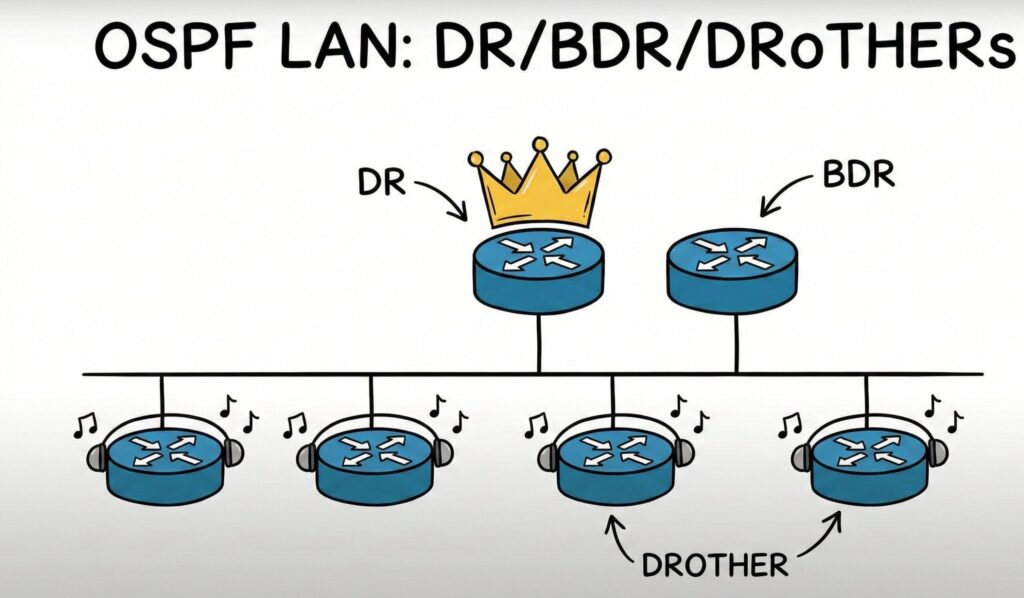
On broadcast multi-access networks (think switched Ethernet), OSPF tries to avoid a full mesh of adjacencies because:
• 20 routers × 19 adjacencies each = chaos
• SPF runs = CPU sadness
• LSA flooding = your network cries
So OSPF elects:
• DR (Designated Router) — The main guy
• BDR (Backup Designated Router) — The understudy
• All other routers become DROTHERs — The supporting cast
Only DRs and BDRs form full adjacencies with everyone.
Routers on the segment send LSAs to the DR, which then floods them.
Think of the DR as the group chat admin.
Election rules:
• Highest OSPF priority wins
• If tied, highest Router ID
• Elections are sticky — the DR stays DR until it dies
(a fun fact that has caused many “why is THAT router DR?” arguments)
Hello and Dead Timers: The Silent Killers
Mismatch any of these and OSPF adjacencies will never form:
• Hello interval
• Dead interval
• Network type
• Area ID
• Authentication
• Stub flags
You can spend hours troubleshooting OSPF because one router thinks the Hello interval is 10 seconds, and another thinks it’s 30.
OSPF doesn’t compromise. At all.
It’s like two routers arguing about whether to meet at 10 AM or 10:30 AM—except instead of rescheduling, they both just leave.
⸻
Neighbor Problems You Will Definitely Encounter (Eventually)
❌ Stuck in Init
You’re receiving Hellos, but they don’t list you.
Usually a unidirectional link or mismatched network type.
❌ Stuck in ExStart/Exchange
MTU mismatch.
Every network architect’s favorite.
❌ Flapping neighbors
Often timers, unstable links, or a broadcast segment with 50 routers because someone was feeling spicy that day (or choose violence that day).
❌ Stuck in 2-Way
Normal on broadcast…
…but chaos on point-to-point.
⸻
Architect’s Corner: Practical Wisdom
• Avoid giant broadcast domains. DRs cannot save you
• Set router priorities deliberately—never let the access switch win DR.
• MTU mismatches are OSPF’s revenge for not documenting your environment.
• Point-to-point links? Use point-to-point network type.
• Passive interfaces save your LSAs—and your sanity.
⸻
Coming Next: “OSPF Areas – Herding Cats with Hierarchy”
In Post 3, we dive into Area 0, stubs, totally stubs, NSSAs, virtual links, and why OSPF areas are the architectural equivalent of keeping your junk drawer from expanding into the kitchen.