Because Nothing Says ‘Fun Weekend’ Like Memorizing LSA Types
If you’ve made it this far in OSPF, you’re doing better than most.
You’ve survived neighbor states.
You’ve survived areas.
Now it’s time for the part of OSPF that everyone pretends to fully understand during design meetings:
LSAs — Link State Advertisements
OSPF’s postal service, rumor mill, and gossip distribution network all rolled into one.
Once you understand LSAs, the entire protocol clicks into place.
It’s the Rosetta Stone of OSPF—but with more types, more rules, and more opportunities for chaos.
Let’s break down each type, what it does, and when it decides to ruin your day.
What Are LSAs, Really?
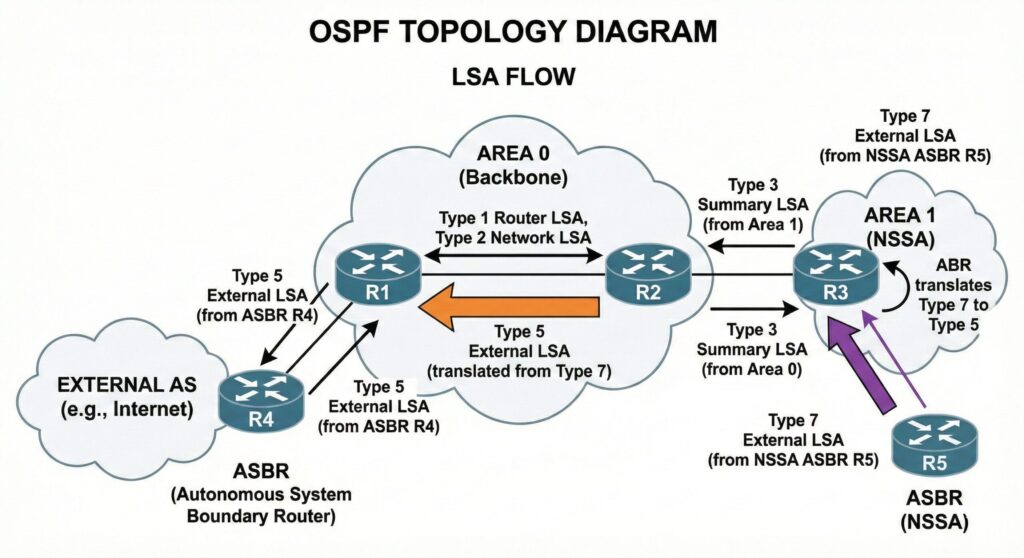
Every router owns a piece of the OSPF map.
LSAs are the “letters” that routers send to communicate:
• What interfaces they have
• What neighbors they see
• What networks exist
• What external routes exist
• What policies apply
• What type of area they’re in
All LSAs get collected into the Link-State Database (LSDB), which forms the basis for running SPF.
Think of LSAs as letters, and SPF as the post office.
LSA Types 1 Through 7: The Cast of Characters
Let’s walk through them like a network architect introducing a dysfunctional family at a holiday dinner.
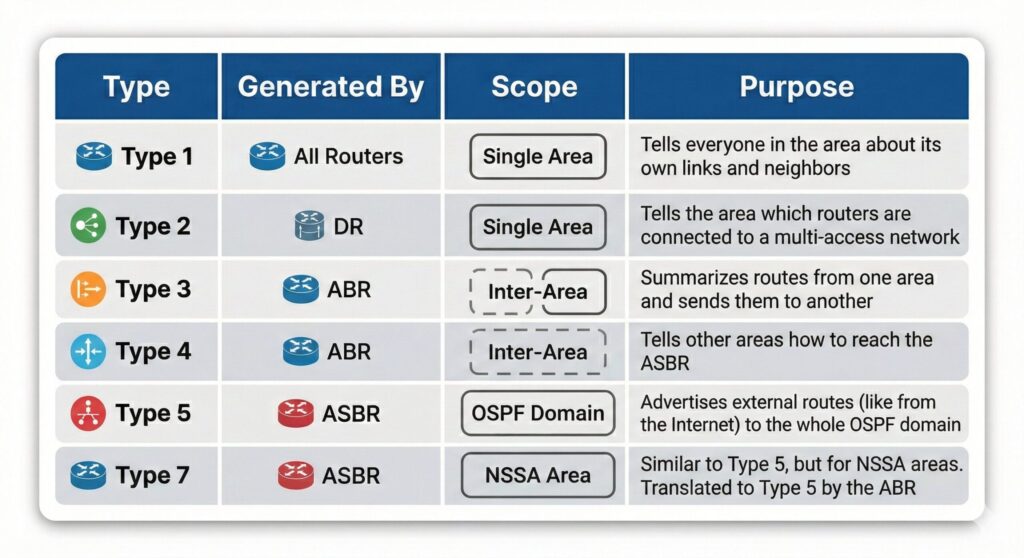
Type 1 — Router LSA (The Autobiography)
Generated by: Every router, in every area it belongs to
Scope: Stays inside its own area
Contains:
• Links (interfaces)
• Link types
• Costs
• States of links
This LSA is a router saying:
“Here’s everything about me inside this area.”
It’s foundational and honest. It’s not dramatic. Every router in the area uses it to understand the topology.
Type 2 — Network LSA (The Party Host List)
Generated by: DRs on broadcast/NBMA networks
Scope: Stays inside the originating area
Contains:
• The DR
• All routers on that multi-access segment
This LSA is basically:
“I’m the DR and here’s everyone who showed up to the Ethernet party.”
If no DR exists, no Type 2 LSA. (Which is exactly why you care about DR elections.)
Type 3 — Summary LSA (The Area Cliff Notes)
Generated by: ABRs
Scope: Other areas
This LSA contains summaries of networks in one area so they can be advertised to another
Think of it as:
“Here’s what Area 1 looks like (in digest form).”
Summary LSAs are the reason OSPF areas scale. They reduce chaos, simplify routing, and keep SPF loops isolated.
Type 4 — ASBR Summary LSA (The External Route Map Legend)
Generated by: ABRs
Used when: There is an ASBR inside an area
Purpose:
Let other areas know how to reach the ASBR so they can use the external routes it advertises.
This LSA basically says:
“There’s an ASBR over there—here’s how to get to it.”
Forget this LSA, and no one knows how to reach the external route source.
Type 5 — External LSA (The Outsider Announcement)
Generated by: ASBRs
Scope: Floods everywhere (except stub areas)
These are routes redistributed from:
• BGP
• Static
• Another IGP
• Anything outside OSPF
There are two different route types, E1 and E2. These determine how the route metric is calculated across the network:
- E1 – External metric + internal OSPF cost to reach the ASBR
- E2 – External metric only (internal cost mostly ignored)
This LSA says:
“I’ve got routes from outside the kingdom. Here they are.”
Type 5 LSAs are powerful—and dangerous.
Enough of them and your LSDB swells like a stressed-out balloon.
Stub areas reject them by design, to protect themselves.
Type 6 — Group Membership LSA (The Forgotten Middle Child)
Purpose: OLD multicast support
Status: Obsolete (replaced by IGMP/MLD)
We don’t use it, don’t talk about it and we pretend it never existed.
Moving on.
Type 7 — NSSA External LSA (The Rule-Bender)
Generated by: ASBRs inside NSSA areas
Scope: Inside NSSA only
Why Type 7 exists:
Stub areas don’t allow Type 5 LSAs,but NSSA areas need to redistribute external routes.
Solution?
Invent a new LSA type.
Classic OSPF.
ABRs later convert Type 7 → Type 5 when flooding into Area 0.
This LSA’s personality is:
“I follow the rules… just not those rules.”
Here is a comparison table for all the LSA’s we talked about
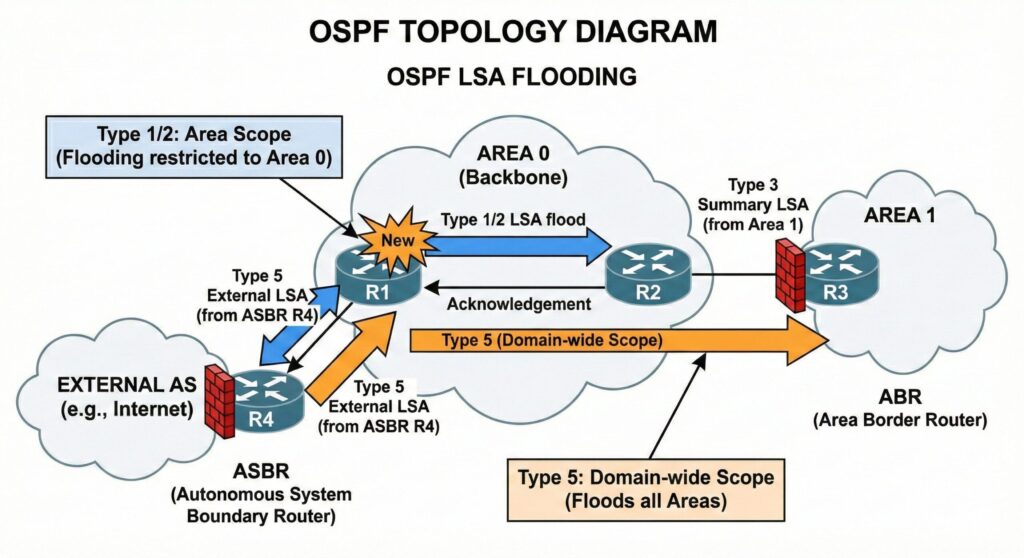
LSA Flooding: How OSPF’s Gossip Network Avoids Chaos
LSAs aren’t just sent once.
They flood reliably, using acknowledgments, age timers, checksums, and careful rules about scope:
• Type 1 and 2 → stay inside the area
• Type 3 and 4 → cross areas
• Type 5 → global
• Type 7 → NSSAs only
OSPF takes LSA flooding very seriously.
It’s how the LSDB stays synchronized enough for SPF to work without meltdown.
LSA Breakdown
Common LSA Issues (You Will See These)
LSA Storm / SPF Thrashing
•   Unstable links
•   Flapping neighbors
•   Misbehaving ABRs
•   Too many external routes
Type 3 Flooding Overload
When someone designs an area like a Costco parking lot.
Type 5 Flooding into Giant Domains
Congratulations, you’ve built an LSDB the size of Tolstoy’s collected works.
Type 7 Weirdness
- ABR not converting to Type 5? Check the following:
- NSSA flags.
- ABR roles.
- for hidden misconfigurations.
⸻
Architect’s Corner: LSA Design Rules You’ll Thank Me For
•   Keep external routes OUT of your backbone when possible
•   Use summarization aggressively on ABRs
•   Don’t redistribute everything—be selective
•   Avoid NSSA unless you truly need redistribution in a stub-like area
•   Limit the size of your areas
•   Keep LSDB clean and stable by reducing topology churn
•   Never, ever, EVER redistribute BGP into OSPF at 3,000 prefixes
(Unless your goal is unemployment.)
Coming Next: “SPF Algorithm – Dijkstra, the Network’s Matchmaker”
Post 5 will break down:
• How SPF works
• How OSPF builds the shortest-path tree
• Why Dijkstra is the unsung hero of your network
• And how path selection really happens under the hood